
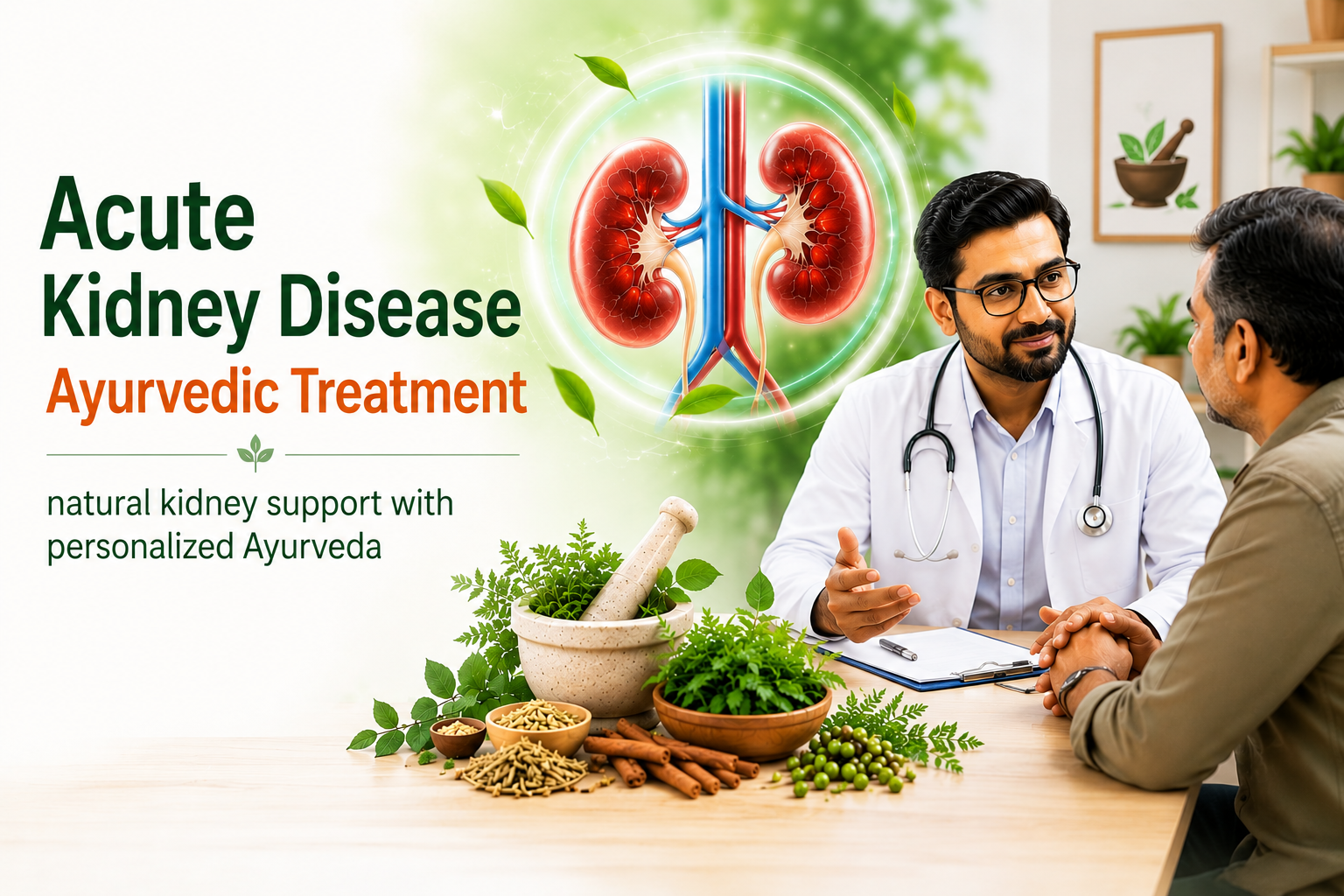
A sudden spike in creatinine. Drastically reduced urine output. Swelling that appears overnight in the legs, face, and abdomen. For thousands of patients every year, these are the alarming first signs of Acute Kidney Injury (AKI) — a rapid, sudden decline in kidney function that, if not addressed immediately and comprehensively, can permanently scar the kidneys and set the stage for Chronic Kidney Disease (CKD) within months.
Conventional medicine handles the crisis phase of acute kidney injury with intravenous fluids, diuretics, dialysis support, and infection control. These are life-saving interventions — and they are necessary. But once the acute phase passes, modern nephrology offers very little to rebuild the damaged kidney tissue, restore the glomerular filtration capacity that was lost during the injury, and prevent the fibrosis and scarring that converts acute kidney injury into permanent chronic kidney disease.
This is the critical window where acute kidney disease ayurvedic treatment delivers outcomes modern medicine cannot — by systematically clearing the residual toxin burden on the kidneys, reducing post-injury inflammation, rebuilding damaged renal tissue, and restoring the metabolic environment that allows the kidneys to recover fully rather than decline progressively.
At Jeevanya Ayurveda in Greater Noida, our certified Ayurvedic doctors have helped hundreds of post-AKI patients recover kidney function, reduce creatinine to normal or near-normal levels, and avoid the progression to dialysis — through personalised, root-cause Ayurvedic protocols built on 25+ years of clinical experience in complex kidney conditions.
What Is Acute Kidney Disease and Why Does It Demand Immediate Attention?
Acute Kidney Injury (AKI) occurs when the kidneys suddenly lose function. Doctors call it Acute Kidney Disease (AKD) when it persists beyond 7 days. Unlike Chronic Kidney Disease, AKD strikes fast — within hours or days. Without proper post-injury support, the consequences can be permanent.
Common Causes of Acute Kidney Disease
Severe dehydration: The kidneys need strong blood flow to filter waste. Vomiting, diarrhoea, heat stroke, or heavy bleeding reduce that flow rapidly. This causes ischaemic injury to the renal tubules. It is the most common AKI cause in India — especially in summer.
Nephrotoxic drugs: NSAIDs like ibuprofen and diclofenac directly damage kidney tubules. So do aminoglycoside antibiotics, imaging contrast dye, and certain antifungal drugs. Long-term or high-dose use is especially harmful.
Infections and sepsis: Systemic infections inflame the kidney’s blood vessels. This impairs filtration and triggers acute tubular necrosis — the most severe AKI pattern.
Obstruction: Kidney stones, enlarged prostate, or tumours block urine flow. This creates back-pressure that damages kidney tissue from within. It is reversible — but only if treated promptly.
Post-surgical AKI: Major surgeries like cardiac bypass reduce kidney perfusion. Patients with existing risk factors face the highest danger.
Why the Recovery Phase Matters Most
The acute crisis is not the biggest threat. What happens after is. Studies show that up to 30% of AKI survivors develop permanent CKD within 3 years. Scar tissue quietly reduces kidney function — even after creatinine appears “normal” on discharge reports.
This recovery window is exactly where Ayurvedic treatment is most powerful.
How Ayurveda Understands Acute Kidney Disease
In Ayurvedic classical texts, the condition closest to acute kidney disease is described under Mutraghata — acute suppression or cessation of urine formation — and is understood as a crisis-level derangement of the Mutravaha Srotas (urinary channels) driven by the combined aggravation of Vata and Pitta doshas.
Vata aggravation causes the acute reduction in urinary flow, the spasm and constriction of renal microvasculature, and the ischaemic injury to the kidney tubules — directly corresponding to the prerenal and renal AKI patterns seen in modern nephrology.
Pitta aggravation drives the inflammatory destruction of kidney tissue — the tubular necrosis, glomerular inflammation, and endothelial damage that characterise sepsis-induced and nephrotoxic AKI.
Ama accumulation — the toxic metabolic residue that builds up rapidly when Agni (digestive and metabolic fire) is overwhelmed by acute illness — floods the Mutravaha Srotas, blocks the kidney’s micro-filtration channels, and perpetuates the inflammatory state long after the initial trigger has been removed. This Ama burden is the primary reason AKD patients continue to have elevated creatinine, reduced GFR, and persistent kidney inflammation even weeks after the acute crisis has resolved.
Ojas Kshaya (vital energy depletion): Severe acute illness profoundly depletes Ojas — the body’s fundamental vital essence. In AKD patients, this manifests as the extreme fatigue, immune vulnerability, poor appetite, and slow tissue recovery that persists long after hospital discharge. Rebuilding Ojas through Rasayana therapy is a critical and often neglected component of complete kidney recovery.
This multi-layered Ayurvedic understanding of AKD is precisely what enables our doctors to design a post-injury recovery protocol that addresses the residual Ama burden, the ongoing Vata-Pitta inflammation, and the Ojas depletion simultaneously — rather than simply waiting and monitoring creatinine as conventional nephrology does.
Acute Kidney Disease Ayurvedic Treatment at Jeevanya Ayurveda: Our Recovery Protocol
At Jeevanya Ayurveda, our AKD treatment protocol is designed specifically for the post-acute recovery phase — the critical 3 to 12-month window after the initial kidney injury, when the right intervention can mean the difference between complete recovery and progressive CKD.
Every patient begins with a comprehensive assessment: Nadi Pariksha (pulse diagnosis), full review of all available lab reports (creatinine, eGFR, BUN, electrolytes, urine protein), imaging reports, and a detailed case history identifying the original cause of AKD, duration of injury, and current kidney function status. Treatment is then built across four integrated pillars:
1. Panchakarma Detoxification for Post-AKI Recovery
Virechana (Therapeutic Purgation) Virechana is the most important Panchakarma therapy for AKD patients in the post-acute recovery phase. A precisely administered medicated purgation clears the residual Pitta and Ama burden from the systemic channels, reduces the ongoing renal tubular inflammation that continues after the acute crisis, and resets the gut-kidney axis — improving the body’s overall metabolic detoxification capacity. Patients who undergo Virechana within 4–8 weeks of an AKI episode consistently show faster creatinine normalisation and better eGFR recovery than those managed on conventional monitoring alone.
Niruha Basti (Decoction Medicated Enema) Basti is the most powerful Vata-pacifying Panchakarma procedure — directly addressing the ischaemic and vasoconstrictive component of kidney injury. Punarnavadi Niruha Basti — using decoctions of Punarnava, Gokshura, Dashamoola, and supportive herbs — reduces renal tubular inflammation, improves kidney microvascular circulation, clears accumulated Ama from the Mutravaha Srotas, and delivers powerful nephroprotective compounds systemically through the colonic route. A structured Basti course of 8–16 sessions, begun 3–4 weeks post-discharge, is the most effective Ayurvedic intervention for preventing AKD-to-CKD progression.
Abhyanga (Medicated Oil Massage) + Swedana (Medicated Steam) Gentle medicated oil massage with Dashamoola Taila followed by mild steam therapy improves peripheral circulation, mobilises residual Ama from deep tissues into the eliminatory channels, reduces generalised oedema, and supports the rebuilding of depleted Dhatus in the post-illness recovery phase. Both therapies are carefully calibrated for AKD patients — avoiding over-stimulation of the kidneys during the fragile recovery window.
2. Ayurvedic Herbal Medicines for Acute Kidney Disease Recovery
Herbs That Protect and Repair Kidney Tissue
Punarnava (Boerhavia diffusa) is the most important kidney-recovery herb in Ayurveda. It reduces renal tubular inflammation and improves urine output — a key AKD recovery marker. It also reduces swelling and fluid retention. Most importantly, it protects the glomeruli from fibrosis. We prescribe it in Punarnavadi Mandoora and Punarnavasava.
Gokshura (Tribulus terrestris) targets the urinary channels directly. It reduces protein loss in urine, repairs injured tubular cells and improves overall kidney filtration. We prescribe it in Gokshuradi Guggulu — which adds Guggulu’s anti-fibrotic power to Gokshura’s nephroprotective action.
Varuna (Crataeva nurvala) clears blocked kidney channels. It reduces urinary inflammation also prevents kidney stones — a common post-AKI complication. It improves urine flow. We prescribe it as Varunadi Kwath, twice daily.
Classical Formulations for Full Kidney Recovery
Chandraprabha Vati addresses the full range of post-AKD problems — high creatinine, proteinuria, low urine output, and general kidney weakness. It combines 37 ingredients including Shilajatu and Guggulu.
Shilajatu repairs kidney cells at the metabolic level. It supplies 85+ ionic minerals. It rebuilds Ojas depleted by illness. Doses are carefully calibrated to your creatinine and eGFR levels.
Guduchi / Giloy reduces post-AKI inflammation. It prevents secondary infections. It clears residual Ama and rebuilds immune strength — especially for patients whose AKD was triggered by sepsis.
Dashamoola reduces renal vasoconstriction. It improves kidney microcirculation and tubular function. We prescribe it as Dashamoola Kashayam and use it in Basti therapy.
3. Kidney-Protective Diet During Recovery
Diet during AKD recovery is not a lifestyle suggestion — it is pharmacology. The wrong foods can spike creatinine and re-injure a fragile recovering kidney within days.
Include: Barley water (the most potent natural diuretic and urinary anti-inflammatory in Ayurveda — drunk warm 2–3 times daily throughout recovery); bottle gourd juice; moong dal khichdi (the most kidney-friendly, easily digestible protein source); coconut water in moderation (consult doctor for potassium level); coriander seed water; pomegranate juice (antioxidant, anti-inflammatory, and demonstrated to improve eGFR in clinical studies); warm water throughout the day (minimum 2–2.5 litres, adjusted to urine output); turmeric in cooking.
Strictly avoid: High-protein foods (red meat, excessive dairy, eggs in large quantities — protein breakdown produces urea and creatinine, directly loading the recovering kidneys); high-potassium foods (bananas, oranges, potatoes, tomatoes — in Stage 3+ AKD recovery, potassium must be carefully managed); high-phosphorus foods (processed cheese, cola drinks, packaged foods); NSAIDs and self-prescribed painkillers — the single most important avoidance in AKD recovery; alcohol; excessive salt; cold and refrigerated food; and carbonated drinks.
4. Lifestyle and Monitoring During AKD Recovery
Stay Hydrated — the Right Way
Hydration is critical during kidney recovery. But the amount matters. Our doctors set daily fluid targets based on your eGFR and urine output. They adjust these targets as your kidney function improves. Never self-prescribe your fluid intake during this phase.
Rest, Sleep, and Stress Reduction
Your body needs deep rest after AKI. Sleep at least 8 hours every night. Avoid physical overexertion. Practice Anulom Vilom pranayama daily. It reduces sympathetic nervous system tension. This improves blood flow to the kidneys. Together, rest and pranayama form the backbone of recovery.
Prevent Secondary Infections
Recovering kidneys are vulnerable to UTIs. A second infection can cause serious re-injury. Our doctors prescribe Guduchi and Gokshura to build urinary immunity. They also provide simple hygiene protocols. Follow them strictly throughout the recovery window.
Track Progress With Regular Lab Tests
We test creatinine, eGFR, BUN, urine protein, and electrolytes every 3–4 weeks. We do this for the first 3 months. These results guide every adjustment in your protocol. Your treatment always matches your current kidney status — not a fixed plan.
Why Choose Jeevanya Ayurveda for Acute Kidney Disease Treatment?
Acute kidney disease ayurvedic treatment at Jeevanya Ayurveda, Greater Noida, starts with one core belief. The post-AKI recovery window matters most. It is also the most neglected phase in kidney care. Ayurveda fills this gap effectively.
Our protocol covers every step of post-AKD recovery. We clear residual Ama through Virechana and Basti. Our Experts help you to rebuild damaged kidney tissue using nephroprotective herbs and prevent fibrosis and CKD progression through Rasayana therapy. We also restore your metabolic environment through a kidney-protective diet.
Many AKD patients develop kidney stones alongside their condition. For them, our kidney stones ayurvedic treatment runs at the same time. It dissolves residual stone fragments and clears the Mutravaha Srotas. Varuna and Gokshura-based formulas prevent stones from coming back.
Looking for complete kidney treatment in ayurveda? We treat AKI, CKD, and kidney stones under one roof. Our approach is personalised, lab-monitored, and built on 25+ years of clinical experience.
Our doctors work alongside your nephrologist. They review every lab report. Track every creatinine value and then adjust your protocol based on results.